
What Are the Best Indicators?
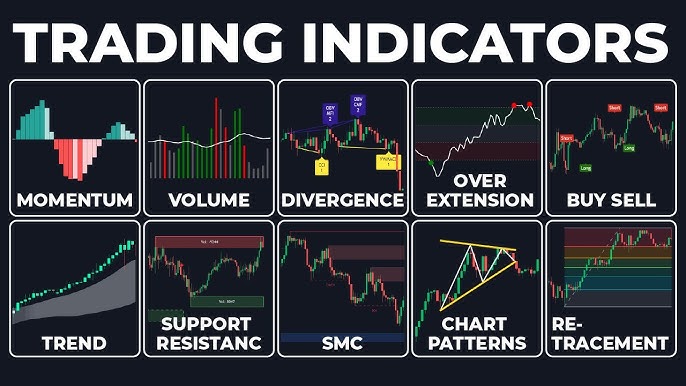
Trading in financial markets—whether forex, stocks, crypto, or commodities—requires decision-making under uncertainty. Since markets are influenced by countless factors, traders rely on tools to help them analyze price movements and identify potential opportunities. One of the most widely used tools in trading is the technical indicator.
This essay explains how indicators work in trading, the different types of indicators, and discusses some of the most effective and widely used indicators. While many traders search for the “best” indicator, the truth is more nuanced: no single indicator guarantees success. Instead, understanding how they work and how to use them properly is what truly matters.
What Are Trading Indicators?
Trading indicators are mathematical calculations based on price, volume, or open interest. They are displayed on charts to help traders interpret market conditions and forecast possible future price movements.
Indicators are derived from historical data. They do not predict the future with certainty but help traders identify patterns, trends, momentum, volatility, and potential reversal points.
Indicators fall under technical analysis, which focuses on studying price charts rather than analyzing economic fundamentals or financial statements.
How Indicators Work
Indicators work by applying mathematical formulas to past market data. For example, an indicator may calculate the average price over the last 14 days or measure how strong a recent price move has been.
There are three main ways indicators help traders:
1. Identifying Trends
Markets tend to move in trends—either upward (bullish), downward (bearish), or sideways (range-bound). Trend indicators help traders determine the direction of the market.
For example, a moving average smooths out price data to show the overall direction. If the price is consistently above the moving average, the market may be in an uptrend.
2. Measuring Momentum
Momentum indicators show the speed and strength of price movements. They help traders determine whether a trend is gaining strength or weakening.
If momentum is strong, a trend is more likely to continue. If momentum slows down, a reversal may be approaching.
3. Identifying Overbought or Oversold Conditions
Some indicators signal when a market may be overbought (price has risen too much) or oversold (price has fallen too much). These conditions can suggest potential reversals.
Types of Trading Indicators
Indicators are generally divided into four main categories:
1. Trend Indicators
These help determine the direction of the market.
Examples:
- Moving Averages (MA)
- Exponential Moving Average (EMA)
- Moving Average Convergence Divergence (MACD)
2. Momentum Indicators
These measure the strength of a price movement.
Examples:
- Relative Strength Index (RSI)
- Stochastic Oscillator
- MACD (also acts as momentum indicator)
3. Volatility Indicators
These measure how much the price fluctuates.
Examples:
- Bollinger Bands
- Average True Range (ATR)
4. Volume Indicators
These analyze trading volume to confirm trends.
Examples:
- On-Balance Volume (OBV)
- Volume Oscillator
Each type of indicator serves a specific purpose. Professional traders often combine different types for better accuracy.
Popular and Effective Trading Indicators
Although no indicator is perfect, some are widely respected and commonly used because of their reliability and simplicity.
1. Moving Average (MA)
The Moving Average is one of the most basic and powerful indicators. It calculates the average price over a specific period.
There are two main types:
- Simple Moving Average (SMA)
- Exponential Moving Average (EMA)
The EMA reacts faster to price changes because it gives more weight to recent prices.
Traders use moving averages to:
- Identify trends
- Find support and resistance levels
- Spot crossovers (e.g., when a short-term MA crosses above a long-term MA)
The Moving Average is best for trend-following strategies.
2. Relative Strength Index (RSI)
The RSI measures momentum and ranges from 0 to 100.
- Above 70 = Overbought
- Below 30 = Oversold
RSI helps traders identify potential reversal points. For example, if RSI rises above 70, the market may be due for a correction.
RSI works well in range-bound markets but may give false signals during strong trends.
3. MACD (Moving Average Convergence Divergence)
MACD is both a trend and momentum indicator. It consists of:
- MACD line
- Signal line
- Histogram
Traders look for:
- Crossovers between MACD and signal line
- Divergence between MACD and price
- Histogram expansion or contraction
MACD is effective for spotting trend changes and momentum shifts.
4. Bollinger Bands
Bollinger Bands consist of:
- A middle moving average
- An upper band
- A lower band
The bands expand during high volatility and contract during low volatility.
When price touches the upper band, the market may be overbought. When it touches the lower band, it may be oversold.
Bollinger Bands are useful for identifying breakouts and volatility changes.
What Is the Best Indicator?
Many beginners ask, “What is the best indicator?”
The honest answer is: There is no single best indicator.
Indicators are tools—not guarantees. Their effectiveness depends on:
- Market conditions
- Trading strategy
- Timeframe
- Risk management
- Trader experience
For example:
- Moving averages work well in trending markets.
- RSI performs better in sideways markets.
- Bollinger Bands are useful during volatility shifts.
Professional traders often combine indicators. For instance:
- Moving Average (trend)
- RSI (momentum)
- ATR (volatility)
This combination provides a more complete market picture.
The Importance of Risk Management
Even the best indicator cannot prevent losses. Markets are unpredictable, and false signals occur regularly.
Successful trading depends more on:
- Risk management
- Position sizing
- Stop-loss placement
- Emotional discipline
An average strategy with strong risk management can outperform a great indicator used recklessly.
Limitations of Indicators
It is important to understand that indicators are based on past data. This means:
- They are lagging tools.
- They react to price rather than predict it.
- They may give false signals in volatile markets.
Relying solely on indicators without understanding price action can lead to poor decisions.
Many experienced traders eventually focus more on price action and use indicators only as confirmation tools.
Conclusion
Trading indicators are powerful analytical tools that help traders understand trends, momentum, volatility, and potential reversals. They work by applying mathematical formulas to historical price and volume data.
Some of the most popular and effective indicators include:
- Moving Averages
- RSI
- MACD
- Bollinger Bands
However, there is no “perfect” or “best” indicator. Success in trading comes from understanding how indicators work, combining them wisely, and applying strong risk management principles.
Ultimately, indicators should support your strategy—not replace critical thinking. The key to long-term success in trading is discipline, continuous learning, and proper risk control rather than relying on any single technical tool.